
Provenance
Acquired or inherited by George Stanhope, 7th Earl of Chesterfield (1831-1871); inherited by Anne Elizabeth Stanhope (née Forester), Countess of Chesterfield (1803-1885); inherited by George Herbert, 5th Earl of Carnarvon (1866-1923); acquired by Baron Ferdinand de Rothschild (1839-1898); inherited by Alice de Rothschild (1847-1922) in 1898; inherited by James de Rothschild (1878-1957) in 1922; 1957, bequest of James de Rothschild to the National Trust.
Essential Literature
Anne L. Poulet and Guilhem Scherf (eds), Clodion: 1738-1814 (Musée du Louvre, 1992), p. 333, figs 175-6; Anne L. Poulet, ‘On the Run: Clodion’s Bacchanalian Figures’, in Heather MacDonald (ed.), French Art of the Eighteenth Century: The Michael L. Rosenberg Lecture Series at the Dallas Museum of Art (Yale University Press, 2016), pp. 176-7.

Claude Michel, known as Clodion (1738-1814)
Running Satyr (1), and Running Bacchante (2)
c. 1775-1800
Terracotta
H. 39.1 cm (1), and H. 38.45 cm (2)
Signed CLODION (N reversed) (1)
Signed CLODION (2)
Waddesdon Manor, Buckinghamshire (no. 2456.1; 2456.2)

Collecting Clodion
In 2019, postgraduate students from Columbia University’s MA in Art History curated a small exhibition entitled Clodion (1738–1814) and “Clodion Mania” in Nineteenth-Century France.[1] The exhibition examined the authorship of two terracotta groups in the university’s collection, Satyr and Two Nymphs and Nymph and Two Satyrs (figs. 1-2). Although both works bear Clodion’s signature and the date “1779” on their bases, inconsistencies in chronology and the substandard execution of certain details – most notably the fruit clusters – have cast significant doubt on their authenticity. The researchers ultimately concluded that both sculptures are forgeries. While Clodion may not enjoy the household-name status of Michelangelo, this case nonetheless illuminates a compelling chapter in the history of Western taste: a period in the late nineteenth century when Clodion’s popularity was so pronounced that he became one of the most frequently forged artists in Europe.


Figure 1. Style of Clodion, Satyr and Two Nymphs, , likely 1800-1899, terracotta with wash, 65.1 x 43.3 x 33.6 cm, New York, Columbia University (no. 1976.12.005).
The nineteenth-century appetite for Clodion was voracious. A 1882 report in the Pall Mall Gazette recounts the plight of Madame Bernage, a Parisian dealer who unwittingly purchased a fake from the curator of the Rouen Museum of Antiquities. The object was ultimately traced back to a forger named Lebroc. Lebroc’s technique was as devious as it was effective: he would deliberately fracture the limbs of his new creations and then ‘mend’ them, artificially soiling the clay to mimic the patina of an eighteenth-century antique.[2] This case, alongside the Columbia University figurines, exemplifies the late nineteenth-century phenomenon defined by Guilhem Scherf as “Clodion Mania”.[3] Driven by the Rococo Revival, Clodion’s playful terracotta groups became highly sought-after by collectors and amateurs.This surge in demand precipitated an extraordinary wave of falsifications and reproductions: alongside deliberate forgeries, the market was saturated with an unprecedented volume of terracotta groups produced ‘after Clodion’.


Figure 2. Style of Clodion, Nymph and Two Satyrs, XIX century (?), terracotta with wash, 72.4 × 43.2 × 37.2 cm, New York, Columbia University (no. 1976.12.006).
In Britain, this “Clodion Mania” manifested in high-end commerce rather than just the black market. By the 1860s, the prestigious manufacturer Wedgwood was capitalising on the trend. They began producing black basaltware replicas of Clodion’s Running Satyr and Running Bacchante (fig. 3), the original now held at Waddesdon Manor (figs. 4-5).[4] Black basalt – a fine, stoneware refined by Josiah Wedgwood I in 1768 – was an ideal medium for these replicas.[5] While Wedgwood often drew from Greek and Roman antiquity, the firm also selected modern masters like Bernini and Roubiliac. That Clodion was included in this “hall of fame” is a testament to his immense commercial prestige.

Figure 3. Wedgwood, Faun and Bacchante, c. 1860, black basalt, H. 37.5 cm, private collection (Credits: Christie’s).
During the Enlightenment, terracotta shifted from a mere preparatory material for sketches to a celebrated medium for finished works. To own a Clodion terracotta was a mark of erudition. Unlike marble, which can feel cold and distant, or bronze, which is unpredictable in the cast, terracotta offered a malleability that allowed Clodion to achieve breathtaking detail. His works, neither painted nor glazed, relied on pure technical mastery.[6]


Figure 4. Clodion, Running Satyr, 1775-1800, terracotta, H. 39.1 cm, Waddesdon Manor, Buckinghamshire (no. 2456.1; Credits: ArtUK).
The celebrity of the Running Satyr and Running Bacchante was solidified in 1868 at the Leeds National Exhibition. Displayed in the ‘Museum of Ornamental Art’ and subsequently featured in the Illustrated London News (figs 6-7), the figures became iconic.[7] It was likely this public exposure that caught the eye of Baron Ferdinand de Rothschild. When building Waddesdon Manor in 1874, the Baron sought to recreate the splendour of the ancien régime. Clodion’s work, with its ‘Transalpine’ elegance, was the perfect fit for his French-inspired boiseries and interiors.[8]


Figure 5. Clodion, Running Bacchante, 1775-1800, terracotta, H. 38.4 cm, Waddesdon Manor, Buckinghamshire (no. 2456; Credits: ArtUk).
Clodion’s genius lay in his ability to blend three distinct influences: the antique, drawing from Virgil and Ovid to depict joyful, pagan themes; the baroque, taking cues from Bernini’s Apollo and Daphne to create compositions that demand to be seen from every angle; and the natural, a meticulous attention to the anatomy of movement.[9] The Running Satyr and Bacchante are not static figures; they are caught in a joyous, dynamic sprint toward one another. This effectiveness, the ability to freeze a moment of Dionysian ecstasy in humble clay, is exactly why collectors (and forgers) couldn’t get enough of him.

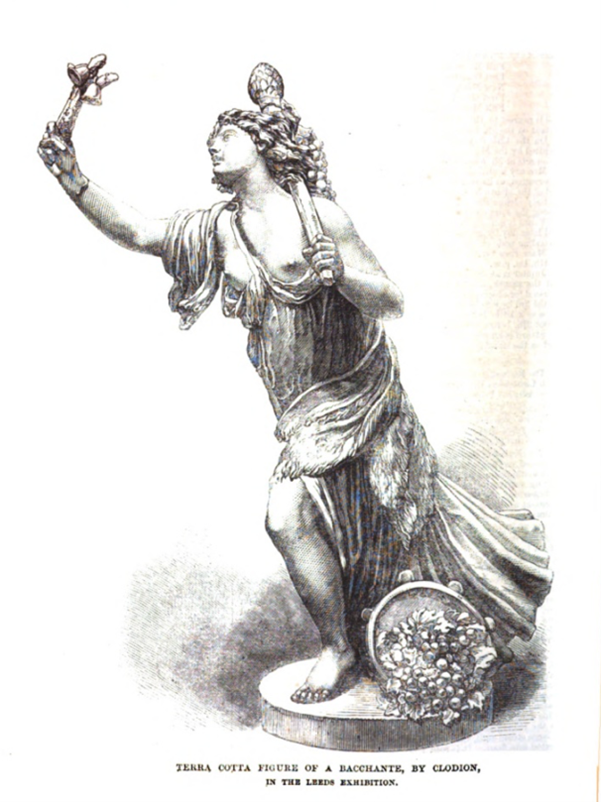
Figures 6-7. Illustration of Clodion’s Running Satyr and Running Bacchante in the Leeds National Exhibition of 1868, in Illustrated London News, 53 (1868), pp. 273, 304.
[1] https://projects.mcah.columbia.edu/ma/node/242 [accessed 03-02-26].
[2] ‘Art Frauds in France’, Pall Mall Gazette, 35 (1882), p. 10.
[3] Guilhem Scherf, ‘Fortune critique’, in Anne L. Poulet, Guilhem Scherf (eds), Clodion: 1738-1814 (Musée du Louvre, 1992), pp. 456-60.
[4] Christie’s New York, 500 Years: Decorative art Europe, Including Oriental Carpets, 15 April 2011, lot. 132.
[5] Classic Black: The Basalt Sculpture of Wedgwood and His Contemporaries, Mint Museum Randolph: https://www.mintmuseum.org/exhibition/classic-black/ [accessed 05-02-2026].
[6] James David Daper, Guilhem Scherf (eds), Playing with Fire. European Terracotta Models, 1740-1840 (Metropolitan Museum of Art, 2003), p. 3; Marjories Trusted, The Making of Sculpture: The Materials and Techiniques of European Sculpture (V&A Publishing, 2007), p. 45.
[7] ‘Leeds National Exhibition’, Illustrated London News, 53 (1868), pp. 273, 304.
[8] The Waddesdon Manor Archive at Windmill Hill, Acc. no. 54: Ferdinand de Rothschild, Red Book, 1897, pp. 2-10 [accessed 05-02-2026].
[9] Poulet and Scherf, Clodion, p. 36; Anne L. Poulet, ‘On the Run: Clodion’s Bacchanalian Figures’, in Heather MacDonald (ed.), French Art of the Eighteenth Century: The Michael L. Rosenberg Lecture Series at the Dallas Museum of Art (Yale University Press, 2016), pp. 176-7.